Financing all Credit Types - 
Financing all Credit Types -
Financing all Credit Types -
Financing all Credit Types -
Most people don’t think about their suspension until something feels off. Maybe the car starts bouncing more than usual, or it just doesn’t feel as stable on the highway.
That’s usually when shocks and struts start becoming noticeable.
They’re not just about comfort, they directly affect handling, braking, and how planted your car feels on the road. When they wear out, it’s rarely sudden. It creeps up slowly, which is why so many drivers don’t realize there’s an issue.
This is one of the most common questions, and honestly, it confuses a lot of people.
At a glance, they seem like the same thing, both deal with bumps and ride quality. But they’re not interchangeable.
The difference comes down to what role they play in the suspension.
Shocks are designed to control movement.
When you hit a bump, your springs compress and rebound. Without shocks, your car would keep bouncing.
Shocks:
absorb that motion
stabilize the ride
keep tires in contact with the road
They don’t support the structure, they just control how things move.
Struts go a step further.
They:
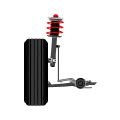
act as a structural part of the suspension
support vehicle weight
help maintain alignment
So while they do the same damping job as shocks, they also hold everything together.
Shocks = control bouncing
Struts = control + structure
This affects repairs:
shocks → easier and cheaper
struts → more complex and expensive
Worn struts can also lead to:
alignment issues
uneven tire wear
noticeable handling problems
Most vehicles use:
struts in the front
shocks in the rear
But it depends on the design, some use one or the other.
They keep your car stable and predictable.
They:
keep tires planted
control movement over bumps
improve braking performance
stabilize steering
Without them, your car would feel loose and uncontrolled.
This is where most people miss it, the wear is gradual.
Common signs:
bouncing after bumps
nose diving when braking
unstable handling
uneven tire wear
Quick check:
Push down on your car. If it keeps bouncing, they’re likely worn.
Drivers usually describe it as:
floaty
unstable
less responsive
It’s not always dramatic - just “off.”
When they get worse, you might hear:
clunking
rattling
knocking over bumps
Most last:
50,000 to 100,000 miles
They can last longer, but performance drops before complete failure.
Don’t wait until they fail completely.
A good rule:
inspect at 50k-60k miles
replace when handling changes
Typical cost:
$300 to $800 per axle
$800 to $1,500+ total
Depends on:
vehicle
labor
parts
alignment
Usually:
1-2 hours per axle
Struts may take longer.
Short term, yes.
Long term is not recommended.
It affects:
braking
control
safety
potholes
rough roads
heavy loads
aggressive driving
No.
If there’s a problem, it needs fixing, not spraying.
Check or replace:
mounts
bushings
bearings
get alignment
test drive
check for noise
Shocks, maybe.
Struts, more complicated and require special tools.
For comfort:
OEM-style
KYB
Monroe
Most models use:
front struts
rear shocks
Typical lifespan:
60k-100k miles
Common options:
local shops
dealerships
national chains
Mobile mechanic companies like Instant Car Fix or Yourmechanic.
A driver called us saying the car just felt “a little off” on the highway.
No noise. No warning lights.
All four shocks were worn.
After replacement, the driver said:
“I didn’t realize how bad it was until now.”
Customer called us for uneven tires.
Problem wasn’t alignment - it was worn struts.
After replacing them and aligning the car, the issue disappeared.
Noise over bumps turned out to be:
worn struts
bad mounts
Fixing both eliminated the noise completely.
Driver with 100k+ miles assumed rough ride was normal.
After replacement:
“It feels like a new car.”
$800-$1,500+
Yes - affects safety.
Yes, especially for struts.
Usually around 50k+
Some locations do.
Shocks and struts wear out slowly, which makes them easy to ignore.
But once they’re replaced, the difference is immediate.
If your car feels even slightly off, it’s worth checking.
Get a real Shock/Strut Assembly service from a mobile mechanic near you, no workshop visit needed.
No commitment • See pricing instantly

Great service! I would definitely use them again if I ever find I need a dead battery replaced with no way to get to a shop except having it towed in. Love that they come directly to your house!


Came out snd fixed my parents car today. Very nice young man my dad said. He did a good job. Thank you.

Reggie was outstanding, quick, and personable. I’ll be sure to Instantaneous Car Fix the next time I’m stuck on the road.

Great service, everything was fine, they were nice and polite, will be using them for all my car needs

The experience is well received mechanic was on time and waited for me and stayed until the fljob is completer

The mechanics were out promptly and completed the service efficiently! The entire experience was easy to manage.

Got his work done quickly and efficiently even though we had some hiccups he stuck through it till the end. Great mechanic great man.

Sergio was fantastic! He was very informative and explained everything to us during the diagnostic. Thank you, Sergio!

Excelent he was very professional and polite my car was running again within 10 minutes after he arrives

Great service! I would definitely use them again if I ever find I need a dead battery replaced with no way to get to a shop except having it towed in. Love that they come directly to your house!
Came out snd fixed my parents car today. Very nice young man my dad said. He did a good job. Thank you.
Reggie was outstanding, quick, and personable. I’ll be sure to Instantaneous Car Fix the next time I’m stuck on the road.
Great service, everything was fine, they were nice and polite, will be using them for all my car needs
The experience is well received mechanic was on time and waited for me and stayed until the fljob is completer
The mechanics were out promptly and completed the service efficiently! The entire experience was easy to manage.
Got his work done quickly and efficiently even though we had some hiccups he stuck through it till the end. Great mechanic great man.
Sergio was fantastic! He was very informative and explained everything to us during the diagnostic. Thank you, Sergio!
Excelent he was very professional and polite my car was running again within 10 minutes after he arrives