Financing all Credit Types - 
Financing all Credit Types -
Financing all Credit Types -
Financing all Credit Types -
If your car makes a clunk when you hit a bump, pulls to one side, or feels loose when braking, there’s a good chance the problem is in the suspension, specifically the control arms.
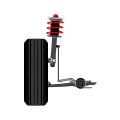
Control arms connect your car’s frame to the wheel assembly. They allow the wheels to move up and down over bumps while keeping them properly aligned and stable. When control arms are in good shape, your car feels planted and predictable. When they wear out, steering, braking, and tire wear all start going downhill.
Most vehicles have control arms in the front suspension, and many also use them in the rear.
A control arm is a solid metal piece, but it isn’t rigidly bolted in place. It moves on:
Bushings at the frame end (rubber or hydraulic)
A ball joint at the wheel end
This setup lets the suspension move while keeping the wheel in the correct position. Over time, the bushings dry out or crack, and the ball joint wears. That’s when problems start.
Lower Control Arm
Supports most of the vehicle’s weight
Handles braking and acceleration forces
Fails more often than the upper arm
Common symptoms: clunking, pulling, vibration when braking
Upper Control Arm
Helps control alignment angles (camber and caster)
Usually lighter and smaller
Wears more slowly
Common symptoms: uneven tire wear, wandering steering
Some cars only have a lower control arm, while others use both. If one side fails, the other side is often not far behind.
The metal arm itself rarely breaks. Problems usually come from:
Worn control arm bushings
Loose or failing ball joints
Rust or corrosion, especially in salt-heavy areas
Potholes or curb impacts
On older vehicles, seized control arm bolts are common and can increase labor time during replacement.
If you notice any of these, your control arms should be inspected:
Clunking or knocking over bumps
Noise when braking or accelerating
Steering wheel vibration
Car pulling left or right
Uneven tire wear
Loose or unstable steering feel
These issues usually get worse quickly once they start.
Most drivers describe it as:
A dull clunk when hitting bumps
A knock when turning into driveways
A sound that gets worse under braking
If the noise changes when braking, the lower control arm bushings are often the cause.
No. This is a safety issue.
If a ball joint or bushing fails completely, the wheel can shift out of position. In extreme cases, the wheel can partially collapse or lose steering control. If your car feels unstable or noisy, it shouldn’t be driven until inspected.
Parts
$100 to $500 per control arm
Depends on vehicle, brand, and whether bushings and ball joint are included
Labor
1 to 3 hours per arm
Rusted bolts can increase labor time
Total Cost
$250 to $900 per control arm, plus alignment
A wheel alignment is required after replacement. Skipping it will ruin tires fast.
Most replacements take:
1–3 hours per arm
Older vehicles or heavily rusted components can take longer.
If you’re experienced and well-equipped, yes. But this isn’t a beginner DIY job.
Challenges include:
Extremely tight or seized bolts
Proper torque specs
Mandatory alignment afterward
Many drivers choose professional repair to avoid safety risks.
There’s no fixed interval, but most last:
70,000 to 120,000 miles
Rough roads and potholes shorten their lifespan significantly.
Dealing with a worn or broken control arm can be stressful. Between towing, scheduling a shop visit, and worrying about costs, it’s easy to put it off but that’s dangerous.
Instant Car Fix brings certified mechanics to you, whether at home, your office, or anywhere convenient. Our mobile technicians can:
Inspect your suspension and identify worn control arms
Replace control arms on-site with high-quality parts
Ensure a proper wheel alignment after the repair
Provide upfront pricing with no hidden fees
This means you get professional service without waiting in a repair shop, and you can drive safely the same day.
Can bad control arms cause shaking when braking?
Yes. Worn lower control arm bushings often cause vibration or instability during braking.
Do control arms affect alignment?
Yes. They directly control camber and caster. Any wear will throw alignment off.
Should both control arms be replaced at the same time?
Strongly recommended. Both sides wear at a similar rate, and it saves on repeat alignments.
Can bad control arms destroy tires?
Absolutely. Uneven tire wear is one of the most common signs.
Are control arms and ball joints the same thing?
No. The ball joint is part of the control arm assembly, but they are separate components.


The cost depends on your vehicle, whether it is an upper or lower arm, and whether the ball joint and bushings come with the new arm. Some vehicles also need an alignment afterward. Because of those variables, the quickest way to an exact number is an instant quote with your vehicle details - transparent, upfront pricing with no hidden fees.
AutoZone sells control arms and parts, but they do not install them - so the price you see there covers the part only, not the replacement. The total job cost depends on your vehicle and what the arm includes. Instant Car Fix supplies quality parts and sends a mobile mechanic to do the work at your home or office, and you can see the full price upfront with an instant quote.
It is usually a mid-difficulty job. The bolts are often large and seized from road exposure, the ball joint has to be separated safely, and the car needs proper support while the suspension is unloaded. Many vehicles also need an alignment afterward. If you are set up for suspension work it is doable at home; otherwise a mobile mechanic can handle it where the car sits, backed by a warranty.
Sometimes. On some vehicles the bushings can be pressed out and replaced on their own, which can cost less. On others the bushings are not sold separately, the arm is worn or rusted, or pressing new bushings costs nearly as much as a complete arm. A mechanic can inspect the arm and tell you which route makes sense for your vehicle.
Common signs include clunking or knocking over bumps, the steering wheel wandering or the car pulling, uneven tire wear, and vibration under braking. A mechanic can confirm by checking for play: a dried, cracked, or separated bushing lets the control arm shift where it should stay put. These symptoms can overlap with other suspension wear, so an inspection pins down the cause.
No - they work together but they are different parts. The control arm is the metal link between the frame and the wheel assembly. The bushings are the rubber or hydraulic cushions at the arm's mounting points that let it pivot while absorbing vibration. Bushings often wear out first, which is why a worn bushing can sometimes be replaced without replacing the whole arm.
Get a real Control Arm service from a mobile mechanic near you, no workshop visit needed.
No commitment • See pricing instantly

Needed a subframe cradle replaced for a 2014 Dodge Charger 5.7. Left the mechanic this morning. I had to go to work. Got back from work. Checked on my vehicle turned it on, and no more engine vibration inside my cabin. Job well done. Thank you.


Jelson monterrosa and Adrian gee Did a fantastic job work , quick and efficient , and i'm very happy with the work they did to my vehicle definitely would call them again They were absolutely the best

Somewhat hesitant as it was a website I had never used before, but the mechanic came out. Performed the service, quick and efficient and good to go.

Sergio fixed the car really fast and it drives and sounds much better than before. I would recommend having him fix any car again

Dustin did a fantastic job getting my broken bolt out fast and efficiently. I can now continue my project. Thank you!

My mobile mechanic Donny was fantastic. He arrived promptly, diagnosed the issue right away, and replaced my battery quickly and efficiently. He’s extremely knowledgeable and clearly an expert in his field. I really appreciated his professionalism and the smooth experience from start to finish. I would gladly use his services again and highly recommend him to anyone needing reliable mobile auto repair.

Used this site first time and got good results,mechanic came on time ,did all testing and diagnostic,found out our battery not working right.We happy with service.

Although there was some confusion about our appointment window. I found customer service to be extremely helpful. My only suggestion would be that there is the opportunity to chat with the actual mechanic. I was arranging service for my father, who’s out of town and had some memory issues, so it would’ve made it much easier to coordinate and understand if I could chat with the mechanic.

Mr. Jimmy is great and very good with his work. I would recommend him again to do the work. Thank you!

Needed a subframe cradle replaced for a 2014 Dodge Charger 5.7. Left the mechanic this morning. I had to go to work. Got back from work. Checked on my vehicle turned it on, and no more engine vibration inside my cabin. Job well done. Thank you.
Jelson monterrosa and Adrian gee Did a fantastic job work , quick and efficient , and i'm very happy with the work they did to my vehicle definitely would call them again They were absolutely the best
Somewhat hesitant as it was a website I had never used before, but the mechanic came out. Performed the service, quick and efficient and good to go.
Sergio fixed the car really fast and it drives and sounds much better than before. I would recommend having him fix any car again
Dustin did a fantastic job getting my broken bolt out fast and efficiently. I can now continue my project. Thank you!
My mobile mechanic Donny was fantastic. He arrived promptly, diagnosed the issue right away, and replaced my battery quickly and efficiently. He’s extremely knowledgeable and clearly an expert in his field. I really appreciated his professionalism and the smooth experience from start to finish. I would gladly use his services again and highly recommend him to anyone needing reliable mobile auto repair.
Used this site first time and got good results,mechanic came on time ,did all testing and diagnostic,found out our battery not working right.We happy with service.
Although there was some confusion about our appointment window. I found customer service to be extremely helpful. My only suggestion would be that there is the opportunity to chat with the actual mechanic. I was arranging service for my father, who’s out of town and had some memory issues, so it would’ve made it much easier to coordinate and understand if I could chat with the mechanic.
Mr. Jimmy is great and very good with his work. I would recommend him again to do the work. Thank you!