Financing all Credit Types - 
Financing all Credit Types -
Financing all Credit Types -
Financing all Credit Types -
A clunk over a bump can put a control arm, a ball joint, or several other suspension parts on the repair estimate. But the sound does not identify the failed part. Replacing whichever component appears first in a search result can leave the original problem untouched.
Bad control arm symptoms and ball joint symptoms overlap because these parts help hold the wheel in position while the suspension moves. The useful question is where unwanted movement is happening, and what a vehicle-specific inspection shows.
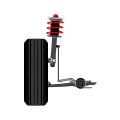
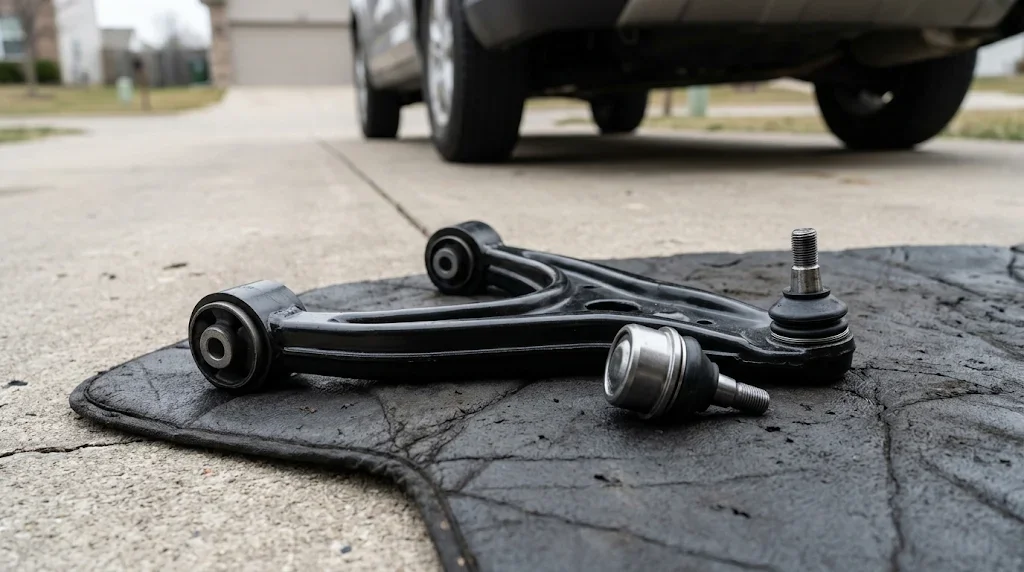
A control arm links the wheel assembly to the vehicle's structure. Its mounting bushings allow controlled movement and help isolate vibration. Depending on the design, a ball joint connects the arm to the steering knuckle, allowing the wheel to move with the suspension and turn for steering.
A repair described as a "control arm problem" might involve a damaged metal arm, a worn bushing, or a ball joint supplied with the assembly. Ask which part actually failed. A complete arm on the estimate does not necessarily mean the metal arm itself is damaged.
When the noise happens helps guide the inspection, but it does not identify which part needs replacing.
Tell the mechanic whether you also feel pulling, vibration, or looseness. Describe a recent pothole impact or repair. Do not drive repeatedly over a bump or brake hard to demonstrate the problem.
The broader suspension diagnosis matters because one noisy connection can resemble another. Quiet operation on a smooth road does not clear a joint that moves abnormally under a different load.
Worn joints or bushings may let wheel position change, affecting steering feel or tire wear. But pulling to one side can also involve tires, brakes, or alignment. It is not proof of a control arm fault.
Likewise, steering wheel shaking calls for attention to when it occurs: at a particular speed, under braking, or after hitting uneven pavement. That pattern helps direct testing without establishing the answer by itself. Our guide to a car that shakes while driving covers the wider vibration checks.
Note tire wear you can see while standing beside the parked vehicle. Do not reach under the car or crawl underneath to examine a suspected loose component.
A useful inspection locates movement at the component rather than judging only how far the tire rocks. A mechanic checks the arm and mounting points, bushing condition, joint boots, and related steering and suspension parts. Tie rod ends deserve attention because steering looseness can come from them too.
How the suspension is supported matters. Some joint checks require unloading a particular connection; others use a wear indicator with the vehicle's weight applied. The correct procedure depends on the suspension and the joint installed, not one universal jacking point or wheel-shaking trick.
Where measurement is required, the technician compares the findings with the applicable service information. A torn boot, visible rubber damage, or a noise may justify closer examination, but the repair recommendation should explain what was found and why it warrants replacement.
At a bushing, the question is whether the mount is damaged or moving beyond its intended range, not whether the rubber flexes at all. At a ball joint, the technician checks the pivot itself for wear or abnormal movement. A bent arm or damaged attachment point is a separate finding.
On some vehicles, a bushing or ball joint can be replaced separately. On others, the available repair uses a complete arm. The arm's condition, parts design, installation requirements, and labor involved affect that choice.
Ask whether the assembly includes new bushings and a ball joint, and why separate replacement is or is not suitable. The opposite side should be inspected, but a failed part on one side does not establish that the matching part has failed too.
Ask whether an alignment check or adjustment is required after the specific repair. Alignment cannot repair a loose joint, so the mechanical problem needs attention before alignment is treated as the solution.
Stop safely and arrange assistance if steering suddenly becomes loose or unpredictable, the car is difficult to control, or a wheel appears displaced. A separating suspension joint can compromise wheel control.
A new clunk without those signs still needs prompt inspection. Its loudness, how long it has existed, or whether it disappears cannot establish a safe driving distance. Explain the symptoms before deciding whether the vehicle should be driven to inspection or transported.


Control arm bushings, tie rod ends, stabilizer links, strut mounts, and wheel bearings can produce overlapping complaints. The location of looseness and the correct inspection procedure distinguish them more reliably than the sound alone.
A confirmed defective ball joint needs repair, not a mileage allowance. If steering is unstable or a wheel looks displaced, stop safely and arrange transport. Ask the inspecting mechanic how the documented condition affects moving the vehicle.
There is no universal upper-versus-lower answer. Suspension layout, joint loading, contamination, damage, and vehicle use affect wear. Some vehicles do not have both upper and lower ball joints. Inspection should follow the actual design.
Clunks, wandering, vibration, or uneven tire wear can prompt an inspection, but none confirms a ball joint by itself. The mechanic needs to check that joint using its specified support, loading, and measurement procedure.
It depends on access and whether the joint is bolted, pressed, or incorporated into another assembly. Required tools, corrosion, and the vehicle's repair procedure affect the work. Confirm what the estimate includes before approving it.
A worn joint may clunk, knock, or squeak as the suspension or steering moves. Other parts can make similar sounds. Report the conditions that trigger the noise rather than using its name to choose the replacement part.
Book an Instant Car Fix mechanic to come to you. We service most areas nationwide.

Sergio fixed the car really fast and it drives and sounds much better than before. I would recommend having him fix any car again


Mr. Jimmy is great and very good with his work. I would recommend him again to do the work. Thank you!

Somewhat hesitant as it was a website I had never used before, but the mechanic came out. Performed the service, quick and efficient and good to go.

My mobile mechanic Donny was fantastic. He arrived promptly, diagnosed the issue right away, and replaced my battery quickly and efficiently. He’s extremely knowledgeable and clearly an expert in his field. I really appreciated his professionalism and the smooth experience from start to finish. I would gladly use his services again and highly recommend him to anyone needing reliable mobile auto repair.

Jelson monterrosa and Adrian gee Did a fantastic job work , quick and efficient , and i'm very happy with the work they did to my vehicle definitely would call them again They were absolutely the best

Dustin did a fantastic job getting my broken bolt out fast and efficiently. I can now continue my project. Thank you!

Used this site first time and got good results,mechanic came on time ,did all testing and diagnostic,found out our battery not working right.We happy with service.

Needed a subframe cradle replaced for a 2014 Dodge Charger 5.7. Left the mechanic this morning. I had to go to work. Got back from work. Checked on my vehicle turned it on, and no more engine vibration inside my cabin. Job well done. Thank you.

Although there was some confusion about our appointment window. I found customer service to be extremely helpful. My only suggestion would be that there is the opportunity to chat with the actual mechanic. I was arranging service for my father, who’s out of town and had some memory issues, so it would’ve made it much easier to coordinate and understand if I could chat with the mechanic.

Sergio fixed the car really fast and it drives and sounds much better than before. I would recommend having him fix any car again
Mr. Jimmy is great and very good with his work. I would recommend him again to do the work. Thank you!
Somewhat hesitant as it was a website I had never used before, but the mechanic came out. Performed the service, quick and efficient and good to go.
My mobile mechanic Donny was fantastic. He arrived promptly, diagnosed the issue right away, and replaced my battery quickly and efficiently. He’s extremely knowledgeable and clearly an expert in his field. I really appreciated his professionalism and the smooth experience from start to finish. I would gladly use his services again and highly recommend him to anyone needing reliable mobile auto repair.
Jelson monterrosa and Adrian gee Did a fantastic job work , quick and efficient , and i'm very happy with the work they did to my vehicle definitely would call them again They were absolutely the best
Dustin did a fantastic job getting my broken bolt out fast and efficiently. I can now continue my project. Thank you!
Used this site first time and got good results,mechanic came on time ,did all testing and diagnostic,found out our battery not working right.We happy with service.
Needed a subframe cradle replaced for a 2014 Dodge Charger 5.7. Left the mechanic this morning. I had to go to work. Got back from work. Checked on my vehicle turned it on, and no more engine vibration inside my cabin. Job well done. Thank you.
Although there was some confusion about our appointment window. I found customer service to be extremely helpful. My only suggestion would be that there is the opportunity to chat with the actual mechanic. I was arranging service for my father, who’s out of town and had some memory issues, so it would’ve made it much easier to coordinate and understand if I could chat with the mechanic.