Financing all Credit Types - 
Financing all Credit Types -
Financing all Credit Types -
Financing all Credit Types -
There’s no reliable number of days or miles you can drive with a bad purge valve. If the check engine light is steady and the car feels normal, check your owner’s manual and arrange a diagnosis soon. If the engine stalls while you’re driving, pull over as soon as it’s safe and arrange help. If the light flashes, follow your owner’s manual and get prompt service. Tell the mechanic if the car is especially hard to start right after you fill up.
Your fuel tank does not vent gasoline vapor straight into the air. The vapor goes into a charcoal canister, which stores it. The purge valve is the gate between that canister and the engine. When the computer decides conditions are right, it opens the gate and the engine burns the stored vapor as part of normal operation.
That is the whole job. Open when told, seal shut the rest of the time. When the valve sticks, the balance breaks in one of two directions, and which direction it fails in changes what you feel behind the wheel. If you want the full picture of how this valve differs from its neighbors, the breakdown of purge valve vs vent valve vs charcoal canister walks through all three parts.
A valve stuck open acts like a vacuum leak. Vapor flows into the intake when the engine never asked for it, the air-fuel mix goes off, and you get a rough idle, hesitation, or hard starting. The classic version: the car cranks and cranks right after a fill-up. That pattern is so common it has its own write-up on why a car will not start after getting gas.
A valve stuck closed is quieter. Vapor stays trapped in the canister instead of being burned, and you might feel nothing at all while driving.
Both versions usually set a check engine light with an EVAP code. If your light is on and you have not had it read yet, a check engine light diagnosis is the fastest way to find out whether the purge valve is the actual culprit or just a suspect.
Most purge valve problems are not pull-over-now emergencies. Some situations are different:
• If the engine stalls while you’re driving, pull over as soon as it’s safe and arrange help
• If you smell strong fuel vapor inside or around the car, pull over as soon as it’s safe and arrange help
• If the starter spins the engine but it never catches, stop trying and arrange help
• If the check engine light is flashing, follow your owner’s manual and get prompt service - a flashing light can indicate a misfire, not just an EVAP fault
Neither a stall nor a fuel smell is worth gambling on.
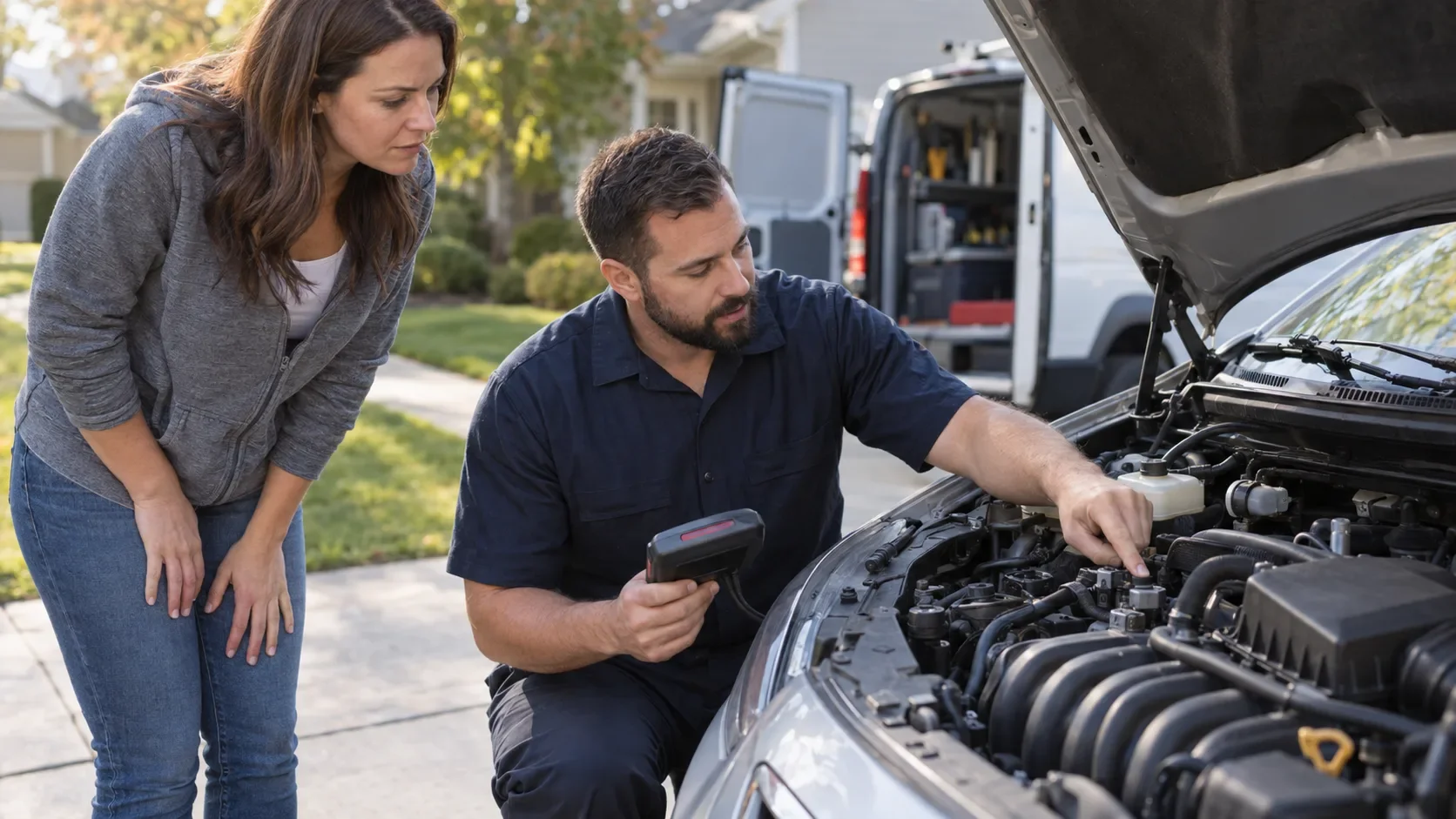
Guessing at EVAP parts gets expensive fast, because the gas cap, the vent valve, the canister, and a dozen hoses can all throw similar codes. A proper diagnosis reads the code, then commands the valve open and closed with a scan tool and checks whether it actually responds. Many mechanics also smoke-test the system to rule out leaks elsewhere.
If the symptoms sound familiar but you have not confirmed the part yet, the full list of symptoms of a bad EVAP purge valve is a good cross-check before you book.
On most cars the valve sits on top of the engine with one connector and one or two hoses. The swap itself is usually one of the quicker repairs on the menu, and it is exactly the kind of job a mobile mechanic can do in your driveway. The valve itself is one of the less expensive parts in the fuel system.
The part that should not be skipped is the verification afterward: clearing the code, running the EVAP monitor, and confirming the system seals. That is what turns "light is off" into "problem is fixed." You can see what the full canister purge valve service covers before you book.
During an inspection of a 2019 Ford Escape SE with about 104,000 miles, an Instant Car Fix mechanic found a fault code related to the purge valve. The job record showed no check engine light or complaint about how the car ran. The mechanic replaced the purge control solenoid where the car was parked in Brockton, Massachusetts.


Usually the first sign is a steady check engine light, sometimes with a rough idle or a car that cranks and cranks right after a fill-up. An illuminated check engine light can also cause an inspection failure where local rules require one. There is no reliable number of safe days or miles, so arrange a diagnosis soon.
It is not a part that usually destroys an engine by itself, but it is not harmless either. Depending on how the valve fails, it can make the engine run rough, stall, or refuse to start after refueling. That is why the guidance is to arrange a diagnosis soon rather than keep driving on it.
It can. An illuminated check engine light can cause an inspection failure, and local rules apply, so check the rules where you live. Plan the repair before your inspection date, not after a failed test.
Almost always, but not immediately. The computer usually needs to see the fault on more than one drive cycle before it lights the dash. So a car can feel off before the light confirms it.
A loose or worn gas cap triggers some of the same EVAP codes, so it is the first thing a mechanic checks because it costs nothing to rule out. If tightening or replacing the cap does not clear the code after a few drive cycles, the diagnosis moves to the valve and the rest of the system.
Refueling pushes a large amount of vapor into the EVAP system at once. If the purge valve is stuck open, that vapor floods the intake and the engine struggles to start or runs rough for a minute. Symptoms that show up mainly after fill-ups point strongly at the purge side of the system.
Yes, in most cases. The valve is usually accessible at the top of the engine, the diagnosis runs on a portable scan tool, and the replacement needs only basic hand tools. It is one of the repairs best suited to a driveway visit.
Instant Car Fix mechanics come to your home or office, diagnose the EVAP system on the spot, and replace the valve where the car sits. Book online in minutes.

The mechanic came and diagnosed the bad battery quickly and efficiently! He purchased the battery and replaced it in a timely manner.


Dustin did a fantastic job getting my broken bolt out fast and efficiently. I can now continue my project. Thank you!

Somewhat hesitant as it was a website I had never used before, but the mechanic came out. Performed the service, quick and efficient and good to go.

Was very helpful and went out of his way to run multiple Diagnostics to find the issue, got the job done very fast and put me back on the road.

Sergio fixed the car really fast and it drives and sounds much better than before. I would recommend having him fix any car again

Although there was some confusion about our appointment window. I found customer service to be extremely helpful. My only suggestion would be that there is the opportunity to chat with the actual mechanic. I was arranging service for my father, who’s out of town and had some memory issues, so it would’ve made it much easier to coordinate and understand if I could chat with the mechanic.

Mr. Jimmy is great and very good with his work. I would recommend him again to do the work. Thank you!

These guys show up and do great work. I've had a couple issues with my vehicle and Instant Car Fix helped me fully diagnose and repair all issues with relative ease. Great customer service and great communication. Thanks guys!

Great service! I appreciate how clear Jean Carlos explained everything and even let me know what other areas of my Jeep needed attention. I also appreciated Instant Fix following up with me to schedule my next service. 10/10 would definitely recommend

The mechanic came and diagnosed the bad battery quickly and efficiently! He purchased the battery and replaced it in a timely manner.
Dustin did a fantastic job getting my broken bolt out fast and efficiently. I can now continue my project. Thank you!
Somewhat hesitant as it was a website I had never used before, but the mechanic came out. Performed the service, quick and efficient and good to go.
Was very helpful and went out of his way to run multiple Diagnostics to find the issue, got the job done very fast and put me back on the road.
Sergio fixed the car really fast and it drives and sounds much better than before. I would recommend having him fix any car again
Although there was some confusion about our appointment window. I found customer service to be extremely helpful. My only suggestion would be that there is the opportunity to chat with the actual mechanic. I was arranging service for my father, who’s out of town and had some memory issues, so it would’ve made it much easier to coordinate and understand if I could chat with the mechanic.
Mr. Jimmy is great and very good with his work. I would recommend him again to do the work. Thank you!
These guys show up and do great work. I've had a couple issues with my vehicle and Instant Car Fix helped me fully diagnose and repair all issues with relative ease. Great customer service and great communication. Thanks guys!
Great service! I appreciate how clear Jean Carlos explained everything and even let me know what other areas of my Jeep needed attention. I also appreciated Instant Fix following up with me to schedule my next service. 10/10 would definitely recommend