Financing all Credit Types - 
Financing all Credit Types -
Financing all Credit Types -
Financing all Credit Types -
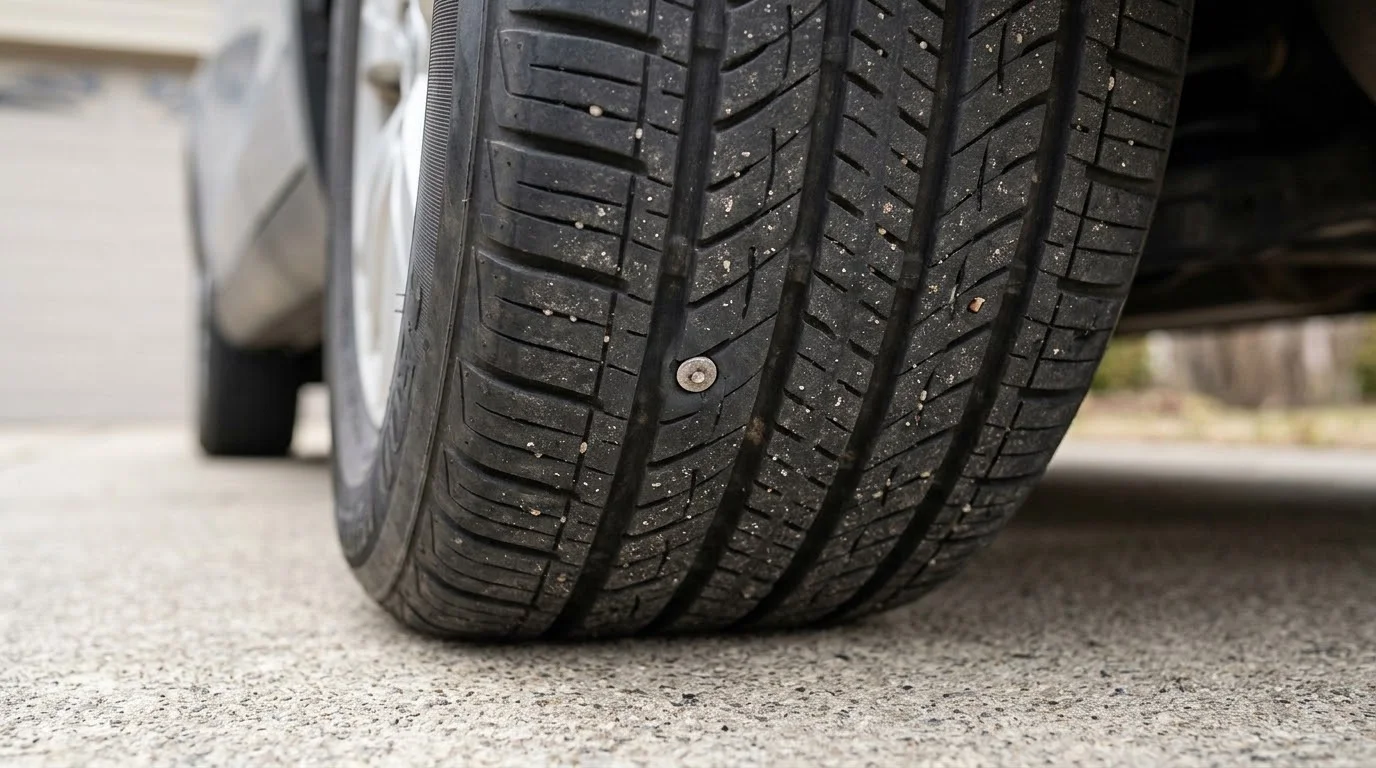
A nail in a tire does not automatically mean buying a new tire. It also does not tell you that a repair will be safe. The answer depends on the actual puncture, the tire's condition and the tire maker's rules.
Leave the nail where it is until the tire can be assessed. A quiet tire and an unlit pressure warning don't tell you whether it's safe to drive.
The nail may not have gone through the inner liner. Or it may have entered at an angle, leaving more damage inside than the small hole suggests. Looking at the nail head will not settle either question.
A technician checks where air is escaping, including the wheel and valve. Finding a nail does not rule out a second leak. Before approving a puncture repair, the tire has to come off the wheel for an internal inspection.
Tell the technician if the tire was driven low or flat, has needed air repeatedly, or already has a plug or sealant in it. Those details matter. Inflating a damaged tire does not undo damage caused by driving underinflated.
The U.S. Tire Manufacturers Association limits repairs within its passenger and light-truck tire guidance to the repairable tread area and puncture injuries no greater than 1/4 inch, or 6 mm. That is an initial limit, not a guarantee that a particular tire can be saved.
Damage reaching the shoulder or belt-edge area is outside that repair boundary. That includes a puncture that starts in the tread but angles into the shoulder. A sidewall puncture is not repairable under this guidance. Do not assume that a spot is repairable simply because it has tread blocks.
The inspection also covers remaining tread, previous repairs and internal damage. Repair units cannot overlap. USTMA says a tire with an existing improper repair must be scrapped. The exact tire maker may impose further restrictions.
A small puncture in the approved tread area may qualify if the tire passes the other checks. Significant internal damage from running underinflated means replacement, even if the visible puncture is small. Ask the technician to show you the injury and explain the decision.
The injury channel needs to be filled, and the inner liner needs to be sealed. USTMA's method calls for a rubber stem and an internal patch. A suitable combination patch-and-stem unit or approved two-piece system provides both.
A plug alone or a patch alone does not meet that method. An outside string plug also leaves the inside of the tire uninspected. Do not assume that a technician can simply add another repair over an old plug. An existing improper repair can rule the tire out.
A tire that holds pressure after inflation can still have internal damage. That is why it has to come off the wheel for inspection.
TPMS warns about significant underinflation. It does not check the tire for structural damage, and an unlit warning light does not prove the pressure is correct.
If you can safely check the parked vehicle, record the tire pressure and whether the tire is cold. For a routine cold-pressure comparison, use the vehicle's tire-information placard or owner's manual, not the maximum pressure printed on the tire sidewall. Do not step into traffic or crawl under the vehicle to inspect it.
A flat tire, rapid pressure loss, a bulge or a change in handling calls for a safe stop and assistance. Do not take a trial drive to see how long it holds up. There is no general safe distance to drive with a nail, and adding air is not a puncture repair. Have a tire professional inspect it.
Run-flat construction does not guarantee that a puncture can be repaired. Nor does it give every tire the same emergency driving distance or speed. Follow the tire and vehicle instructions, and tell the technician about any driving after pressure loss.
Repair policies differ. Goodyear's published bulletin, for example, permits run-flat repair under its specified procedure. That does not make another brand's tire repairable or override internal damage. Self-sealing and foam-lined tires also need product-specific guidance. Identify the exact tire, not just its size.
An emergency mobility kit is not a permanent repair. Follow the kit and vehicle instructions about suitable damage and what to do next. Tell the technician which sealant was used. The tire still needs assessment, and its condition and the applicable policy determine whether repair is possible.
A temporary spare has separate inflation and operating limits. Use the instructions for your vehicle rather than a speed or distance borrowed from another car. If you are unsure whether a spare or kit can be used safely, arrange assistance instead of improvising beside traffic.
Ask what the off-wheel inspection found and whether the proposed repair meets the tire maker's policy. If repair is declined, ask why replacement is needed.
If the recommendation is for more than one new tire, ask which vehicle or tire requirement supports it. Confirm the scope and price before work begins.


No. A small puncture in the repairable tread area may qualify, but the nail does not show the full size or direction of the damage. The tire needs to come off the wheel for an internal inspection. Its condition, earlier repairs and the tire maker's rules all affect the decision.
USTMA guidance for passenger and light-truck tires limits repair to the repairable tread area and puncture injuries no greater than 1/4 inch (6 mm). Damage reaching the shoulder, belt edge or sidewall is outside that boundary, including an angled injury. Even a small center-tread puncture needs the other checks before repair can be approved.
No. USTMA's method calls for both filling the injury channel with a rubber stem and sealing the inner liner with a patch, after the tire has been removed and inspected. A suitable combination unit or approved two-piece system does both jobs. A plug alone or patch alone does not meet that method.
Neither tells you the tire is safe. TPMS does not check for structural damage, and internal damage may not be visible outside. There is no general safe distance to drive with a nail. Stop safely and get assistance if the tire is flat, loses pressure rapidly, has a bulge or changes how the vehicle handles.
Leave the nail in place until the tire can be assessed. Do not enter traffic or crawl under the vehicle to look at it. If you can safely check the parked vehicle, record the pressure. Tell the technician about air loss, any driving while low or flat, and any plug or sealant already used.
It depends on the exact tire and its condition. The tire maker's policy, construction and injury all matter. Tell the technician if you drove after pressure loss, and identify the exact tire before agreeing to a generic plug or patch. A run-flat is not automatically repairable and does not have one universal emergency driving limit.
Instant Car Fix can help you determine the appropriate next step based on your vehicle, tire condition and location. Request a quote to discuss available tire services, including repair or replacement where supported.

Sergio fixed the car really fast and it drives and sounds much better than before. I would recommend having him fix any car again


Needed a subframe cradle replaced for a 2014 Dodge Charger 5.7. Left the mechanic this morning. I had to go to work. Got back from work. Checked on my vehicle turned it on, and no more engine vibration inside my cabin. Job well done. Thank you.

Somewhat hesitant as it was a website I had never used before, but the mechanic came out. Performed the service, quick and efficient and good to go.

Was very helpful and went out of his way to run multiple Diagnostics to find the issue, got the job done very fast and put me back on the road.

Dustin did a fantastic job getting my broken bolt out fast and efficiently. I can now continue my project. Thank you!

Mr. Jimmy is great and very good with his work. I would recommend him again to do the work. Thank you!

Although there was some confusion about our appointment window. I found customer service to be extremely helpful. My only suggestion would be that there is the opportunity to chat with the actual mechanic. I was arranging service for my father, who’s out of town and had some memory issues, so it would’ve made it much easier to coordinate and understand if I could chat with the mechanic.

These guys show up and do great work. I've had a couple issues with my vehicle and Instant Car Fix helped me fully diagnose and repair all issues with relative ease. Great customer service and great communication. Thanks guys!

Great service! I appreciate how clear Jean Carlos explained everything and even let me know what other areas of my Jeep needed attention. I also appreciated Instant Fix following up with me to schedule my next service. 10/10 would definitely recommend

Sergio fixed the car really fast and it drives and sounds much better than before. I would recommend having him fix any car again
Needed a subframe cradle replaced for a 2014 Dodge Charger 5.7. Left the mechanic this morning. I had to go to work. Got back from work. Checked on my vehicle turned it on, and no more engine vibration inside my cabin. Job well done. Thank you.
Somewhat hesitant as it was a website I had never used before, but the mechanic came out. Performed the service, quick and efficient and good to go.
Was very helpful and went out of his way to run multiple Diagnostics to find the issue, got the job done very fast and put me back on the road.
Dustin did a fantastic job getting my broken bolt out fast and efficiently. I can now continue my project. Thank you!
Mr. Jimmy is great and very good with his work. I would recommend him again to do the work. Thank you!
Although there was some confusion about our appointment window. I found customer service to be extremely helpful. My only suggestion would be that there is the opportunity to chat with the actual mechanic. I was arranging service for my father, who’s out of town and had some memory issues, so it would’ve made it much easier to coordinate and understand if I could chat with the mechanic.
These guys show up and do great work. I've had a couple issues with my vehicle and Instant Car Fix helped me fully diagnose and repair all issues with relative ease. Great customer service and great communication. Thanks guys!
Great service! I appreciate how clear Jean Carlos explained everything and even let me know what other areas of my Jeep needed attention. I also appreciated Instant Fix following up with me to schedule my next service. 10/10 would definitely recommend