Financing all Credit Types - 
Financing all Credit Types -
Financing all Credit Types -
Financing all Credit Types -
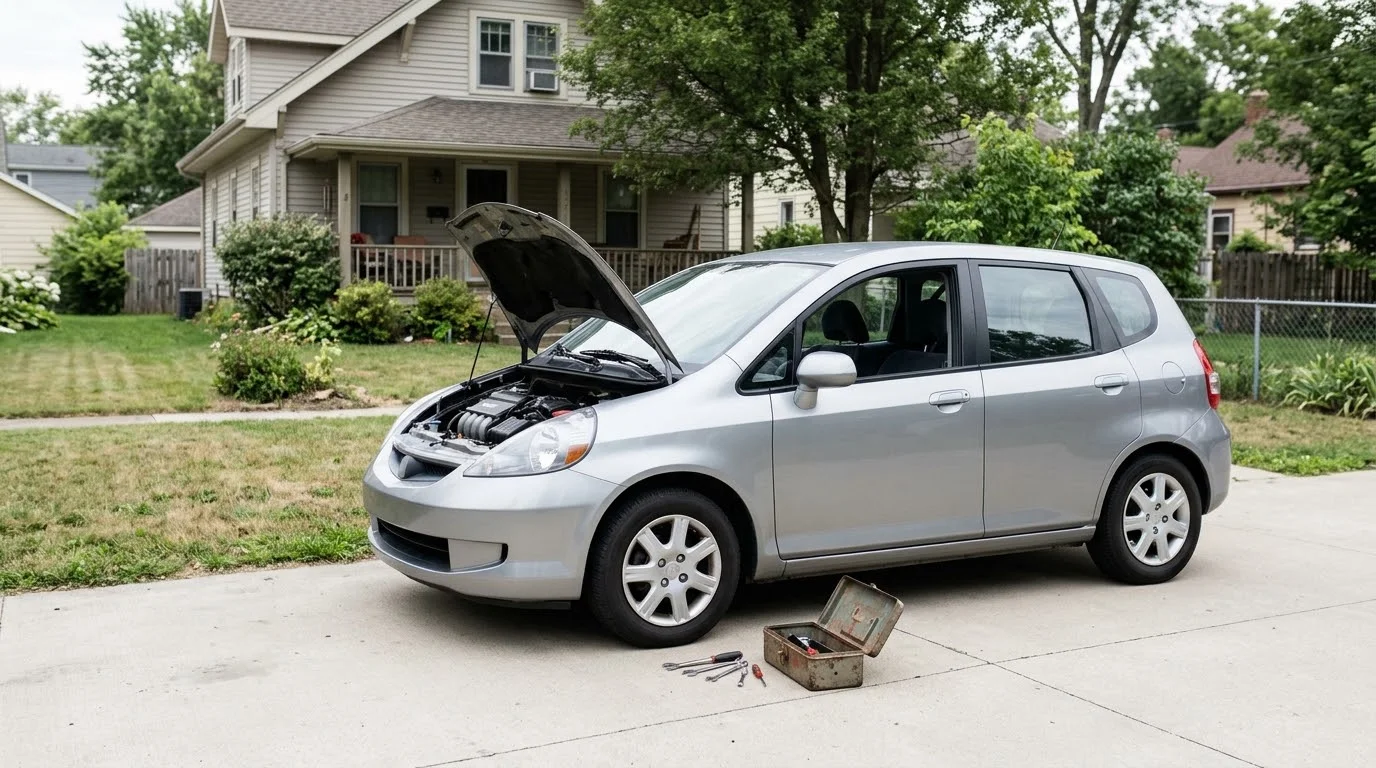
If you do not have a garage, look for a purpose-built DIY repair bay or a private driveway where you have permission to do the specific job. A mobile mechanic may be another option at an approved, suitable location, but an empty parking space or a vehicle-storage rental is not automatic permission to repair a car. Choose the location before you take anything apart, including a plan for what happens if the car cannot move afterward.
Having the tools is only half the problem. You also need somewhere you can finish the work without being told to move a car that no longer has its wheels on.
The right space depends on the job. Replacing a wiper blade and taking an engine apart call for very different arrangements.
Use this as a starting point, not permission to work at a particular property:
A place that allows a quick battery replacement might not allow a brake job, fluid change or vehicle left on stands. Describe the actual work when asking for permission.
Search for a "DIY auto repair shop," "self-service garage" or "automotive bay rental," then contact the operator. Confirm it is a facility that permits customers to repair their own vehicles, rather than a conventional shop or parking-space rental.
Before paying, ask:
Do not assume every bay comes with a mechanic to finish the job. Ask what help, if any, is included. A low hourly rate is not the whole cost if the car must stay somewhere while you wait for parts.
A driveway can work when the owner agrees, the property rules allow the job and the setup is safe. Agree on how long you can use it, where parts will go and what happens if the car cannot be reassembled that day.
For lifting work, follow the vehicle manufacturer's lifting and support instructions. Use correctly rated equipment on a hard, level surface, and secure the vehicle against movement. If you do not have a safe setup or know how to use it, do not get underneath the car.
Think about the space around it, too. You need room to work without blocking another vehicle, a walkway or emergency access. Check the weather and lighting before starting an outdoor job.
Read the lease, parking agreement and community rules. Ask management whether the specific work is allowed, including whether a visiting mobile mechanic may do it. Get the answer in writing where possible.
An assigned space does not settle questions about lifting a vehicle, spills, noise or leaving it disabled. Property approval also does not replace any applicable local requirements.
Online accounts of someone changing brakes in a store parking lot do not establish that the store permits it. Ask the property operator rather than relying on an empty corner of the lot.
For public streets, check the local rules before planning repair work. This guide cannot establish what your city allows. If you are stranded beside moving traffic, arrange safe assistance rather than turning the roadside into a planned workspace.
Vehicle storage and workshop use are different things. Extra Space Storage, for example, explicitly says customers cannot work on cars in its storage units or use them as workshops. That is its policy, not a claim about every storage business.
If another operator offers repair space, confirm that the agreement permits your actual work, equipment and fluid handling. A unit being large enough for the car does not answer those questions. Never run an engine inside an enclosed storage unit.
If your main problem is getting the car repaired rather than doing the work yourself, a mobile service may remove the need to rent a bay or buy equipment.
Instant Car Fix is a mobile service that comes to locations such as homes, offices and roadside settings. That does not make every parking space suitable for every repair. Before booking, explain the vehicle's condition, the proposed location, access and any property restrictions so the work and location can be assessed.
Do not assume a mobile appointment overrides an apartment's rules. Get property permission first. If the location or repair is unsuitable, ask about the next step instead of taking the car apart while arrangements are still uncertain.
Before the first bolt comes out, make sure you have:
Keep used oil contained and take it to a collection or recycling facility that accepts it. Do not pour it onto the ground or into a drain. Check separately where other automotive fluids can go; do not assume they belong in the same container.
If the car cannot be driven safely to the workspace, arrange transport. Finding somewhere to repair it does not make the trip there safe.


A friend's or family member's driveway may be an option with permission, subject to property and local rules. Free space still needs to be safe and available for the whole job. There is no universal right to use a public or store parking space for repairs.
Only consider a facility whose agreement expressly permits the proposed work. Some operators prohibit repairs entirely. Ask before renting, not after the car is inside.
Ask both property management and the service provider. Management must permit the visit and work, and the provider needs to assess the job, access and working conditions.
Follow the facility's agreed arrangements. Confirm extension, overnight storage and vehicle-removal terms before booking. Do not plan on leaving a disabled car without the operator's approval.
Tell Instant Car Fix about your vehicle, the problem and where it is parked. Include any access or property restrictions so the proposed service and location can be assessed before you book.

Was very helpful and went out of his way to run multiple Diagnostics to find the issue, got the job done very fast and put me back on the road.


These guys show up and do great work. I've had a couple issues with my vehicle and Instant Car Fix helped me fully diagnose and repair all issues with relative ease. Great customer service and great communication. Thanks guys!

Needed a subframe cradle replaced for a 2014 Dodge Charger 5.7. Left the mechanic this morning. I had to go to work. Got back from work. Checked on my vehicle turned it on, and no more engine vibration inside my cabin. Job well done. Thank you.

Dustin did a fantastic job getting my broken bolt out fast and efficiently. I can now continue my project. Thank you!

Sergio fixed the car really fast and it drives and sounds much better than before. I would recommend having him fix any car again

Great service! I appreciate how clear Jean Carlos explained everything and even let me know what other areas of my Jeep needed attention. I also appreciated Instant Fix following up with me to schedule my next service. 10/10 would definitely recommend

Mr. Jimmy is great and very good with his work. I would recommend him again to do the work. Thank you!

Although there was some confusion about our appointment window. I found customer service to be extremely helpful. My only suggestion would be that there is the opportunity to chat with the actual mechanic. I was arranging service for my father, who’s out of town and had some memory issues, so it would’ve made it much easier to coordinate and understand if I could chat with the mechanic.

Somewhat hesitant as it was a website I had never used before, but the mechanic came out. Performed the service, quick and efficient and good to go.

Was very helpful and went out of his way to run multiple Diagnostics to find the issue, got the job done very fast and put me back on the road.
These guys show up and do great work. I've had a couple issues with my vehicle and Instant Car Fix helped me fully diagnose and repair all issues with relative ease. Great customer service and great communication. Thanks guys!
Needed a subframe cradle replaced for a 2014 Dodge Charger 5.7. Left the mechanic this morning. I had to go to work. Got back from work. Checked on my vehicle turned it on, and no more engine vibration inside my cabin. Job well done. Thank you.
Dustin did a fantastic job getting my broken bolt out fast and efficiently. I can now continue my project. Thank you!
Sergio fixed the car really fast and it drives and sounds much better than before. I would recommend having him fix any car again
Great service! I appreciate how clear Jean Carlos explained everything and even let me know what other areas of my Jeep needed attention. I also appreciated Instant Fix following up with me to schedule my next service. 10/10 would definitely recommend
Mr. Jimmy is great and very good with his work. I would recommend him again to do the work. Thank you!
Although there was some confusion about our appointment window. I found customer service to be extremely helpful. My only suggestion would be that there is the opportunity to chat with the actual mechanic. I was arranging service for my father, who’s out of town and had some memory issues, so it would’ve made it much easier to coordinate and understand if I could chat with the mechanic.
Somewhat hesitant as it was a website I had never used before, but the mechanic came out. Performed the service, quick and efficient and good to go.