Financing all Credit Types - 
Financing all Credit Types -
Financing all Credit Types -
Financing all Credit Types -
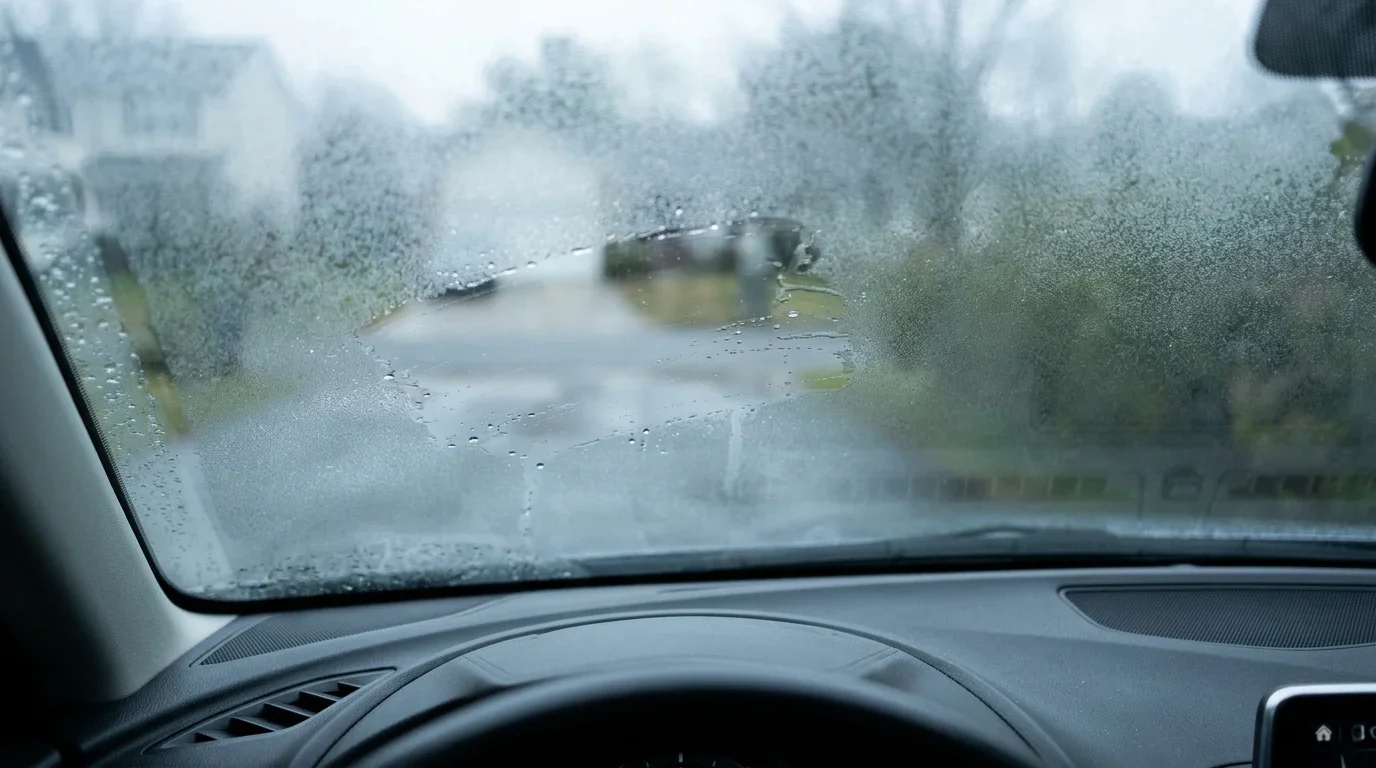
You clear the windshield, start to get ready to leave, and the inside clouds over again. Reaching for a cloth may clear a patch, but it does not explain why the moisture keeps returning. Start with visibility: stay parked until you can maintain a clear view. If fog develops while driving, stop somewhere safe rather than trying to wipe the glass on the move.
Interior fog forms when moisture in the cabin air condenses on cooler glass. That can happen without a failed component. Persistent fogging can also involve excess cabin moisture, weak airflow, an HVAC control problem or a leak. The first useful question is where the moisture is, not which part to replace.
While parked, identify which glass surface is affected. Moisture that the wipers remove is outside. Condensation that remains on the cabin side needs a different response. Do not assume that every cloudy view is fog: a persistent greasy film, dirt or glass damage may need separate attention.
Describe what you see before cleaning it. Does the mist cover all windows or one area? Does it appear with wet passengers, after rain, when the car sits overnight or while the ventilation is running? Those observations help separate humidity from water entering the cabin or an airflow problem. None identifies a failed heater core by itself.
Follow the owner's manual for the defrost or demist mode. On many vehicles, that setting directs air at the windshield, uses outside air and may engage air conditioning to remove moisture. Warm air and dehumidification can work together; selecting heat does not mean A/C has no role.
Control logic and operating limits differ. Some systems change recirculation automatically in defrost mode, and a compressor may not run in all outside temperatures. Do not judge a fault solely from an A/C indicator or apply another vehicle's button sequence. If the prescribed setting will not maintain visibility, the system needs inspection.
Long use of recirculated air can retain cabin moisture and contribute to misting. Use the manufacturer's clearing instructions rather than assuming recirculation will dry the windows faster. Keep the glass clean with a product suitable for the vehicle and any tint or coatings; cleaning is useful maintenance, not a repair for a continuing source of moisture.
Wet floor mats, damp clothing and water carried into the vehicle add moisture. Remove wet items and dry removable floor mats while investigating recurring moisture. While safely parked, note damp carpets or a pattern that follows rain or a wash. Water intrusion can involve seals, drains or another body-related path; it is not automatically an engine-cooling problem.
Report the location of dampness and when it returns. Avoid pulling trim, probing drains or removing parts near airbags to chase the source. A moisture problem may require body or glass-related service rather than mobile mechanical repair. Identifying that boundary can prevent an unnecessary HVAC part replacement.
Little air reaching the windshield calls for an airflow and air-distribution check. The inspection may include intake obstructions, filter condition, blower operation and the doors that direct air. Air that blows strongly but goes to the wrong outlets is a different observation from a fan that does not run.
A temperature-door actuator can affect temperature on applicable systems, while separate mode controls may direct the outlets. The distinction matters: clicking behind the dash or poor windshield airflow does not automatically identify one actuator. The technician checks commands and response before recommending parts.
If moisture removal is poor, AC diagnosis may be relevant. Adding refrigerant without testing is not a general cure for fogged windows. The operating conditions, controls and actual HVAC findings determine the next step.
A persistent greasy film together with coolant odor, unexplained coolant loss or dampness near the heater area raises a different concern from ordinary humid air. A heater core inspection may be needed, but those clues still require confirmation. Wet carpet can have more than one source.
Do not taste fluid or remove a hot cooling-system cap. If overheating, steam or a cooling-system warning occurs, stop safely, switch off and arrange assistance. A clear patch of glass does not resolve the underlying cooling-system problem.
Tell the mechanic which side of the glass fogs, the weather conditions, whether the carpets are damp, how airflow changes with fan speed and whether the specified defrost mode works. Mention recent HVAC, glass or cooling-system work. Photographs taken while parked can document the pattern without recreating it on the road.
The goal is to identify whether the vehicle needs a settings correction, moisture-source repair, airflow work or cooling-system diagnosis. Instant Car Fix can confirm which mechanical checks are suitable at your location. Body-water leaks and some access-intensive work may need another setting. Until visibility can be maintained, leave the vehicle parked.


Rainy conditions, wet items and moisture entering the cabin can raise humidity. The glass may then be cool enough for condensation. Note damp carpet or recurring water as well as whether the prescribed defrost setting clears it.
Use the vehicle's defrost instructions. Many systems combine warm air, outside air and A/C dehumidification. Controls and low-temperature limits vary, so a single button sequence does not suit every vehicle.
Prolonged recirculation can retain moisture. Follow the manufacturer's windshield-clearing setting, which may select outside air or control recirculation automatically.
No. Ordinary humidity, retained cabin water and HVAC performance can all be involved. Coolant odor, loss or a persistent greasy film makes a cooling-system check more relevant, but the source still needs confirmation.
A restricted filter can reduce airflow on applicable systems. It is one item to check when airflow is weak, not proof that every fogging problem needs a new filter.
Wiping removes moisture from the surface without necessarily changing cabin humidity, glass temperature or the source of water. Stay parked and use the prescribed clearing mode; persistent recurrence needs assessment.
Do not set off until you can maintain adequate visibility. If the windshield clouds while moving, stop safely. A temporarily wiped patch is not a dependable substitute for a working clearing system.
Request an HVAC assessment if the prescribed defrost setting cannot keep the windshield clear.

Great service! I appreciate how clear Jean Carlos explained everything and even let me know what other areas of my Jeep needed attention. I also appreciated Instant Fix following up with me to schedule my next service. 10/10 would definitely recommend


Needed a subframe cradle replaced for a 2014 Dodge Charger 5.7. Left the mechanic this morning. I had to go to work. Got back from work. Checked on my vehicle turned it on, and no more engine vibration inside my cabin. Job well done. Thank you.

Sergio fixed the car really fast and it drives and sounds much better than before. I would recommend having him fix any car again

Was very helpful and went out of his way to run multiple Diagnostics to find the issue, got the job done very fast and put me back on the road.

Although there was some confusion about our appointment window. I found customer service to be extremely helpful. My only suggestion would be that there is the opportunity to chat with the actual mechanic. I was arranging service for my father, who’s out of town and had some memory issues, so it would’ve made it much easier to coordinate and understand if I could chat with the mechanic.

Somewhat hesitant as it was a website I had never used before, but the mechanic came out. Performed the service, quick and efficient and good to go.

These guys show up and do great work. I've had a couple issues with my vehicle and Instant Car Fix helped me fully diagnose and repair all issues with relative ease. Great customer service and great communication. Thanks guys!

Mr. Jimmy is great and very good with his work. I would recommend him again to do the work. Thank you!

Dustin did a fantastic job getting my broken bolt out fast and efficiently. I can now continue my project. Thank you!

Great service! I appreciate how clear Jean Carlos explained everything and even let me know what other areas of my Jeep needed attention. I also appreciated Instant Fix following up with me to schedule my next service. 10/10 would definitely recommend
Needed a subframe cradle replaced for a 2014 Dodge Charger 5.7. Left the mechanic this morning. I had to go to work. Got back from work. Checked on my vehicle turned it on, and no more engine vibration inside my cabin. Job well done. Thank you.
Sergio fixed the car really fast and it drives and sounds much better than before. I would recommend having him fix any car again
Was very helpful and went out of his way to run multiple Diagnostics to find the issue, got the job done very fast and put me back on the road.
Although there was some confusion about our appointment window. I found customer service to be extremely helpful. My only suggestion would be that there is the opportunity to chat with the actual mechanic. I was arranging service for my father, who’s out of town and had some memory issues, so it would’ve made it much easier to coordinate and understand if I could chat with the mechanic.
Somewhat hesitant as it was a website I had never used before, but the mechanic came out. Performed the service, quick and efficient and good to go.
These guys show up and do great work. I've had a couple issues with my vehicle and Instant Car Fix helped me fully diagnose and repair all issues with relative ease. Great customer service and great communication. Thanks guys!
Mr. Jimmy is great and very good with his work. I would recommend him again to do the work. Thank you!
Dustin did a fantastic job getting my broken bolt out fast and efficiently. I can now continue my project. Thank you!