Financing all Credit Types - 
Financing all Credit Types -
Financing all Credit Types -
Financing all Credit Types -
If your car only overheats when you're actually driving but sits there idling just fine, that’s usually a sign of a deeper cooling issue.
We run into this quite a bit at Instant Car Fix, and it tends to confuse people because it feels backwards.
Most assume:
“If it’s overheating, it should do it all the time.”
But that’s not how it works.
A typical scenario looks like this:
You’re driving on the highway → temp starts creeping up
You slow down or stop → temp drops back to normal
That pattern is actually a huge clue.
It tells you the system isn’t keeping up when the engine is working harder.
A lot of people jump straight to the radiator fan.
But here’s the thing, at highway speeds, the fan barely matters.
You’ve already got plenty of airflow.
So if overheating is happening while driving, the problem is usually somewhere else.
Most of the time, it comes down to one of two things:
Coolant isn’t moving the way it should
Heat isn’t being removed fast enough
Before replacing any parts, it's important to determine why your vehicle overheats only while driving. Start by checking the coolant level. If the coolant is low, inspect the radiator, hoses, water pump, and reservoir for leaks.
Next, pay attention to exactly when the overheating occurs. Does it happen only at highway speeds? Only while accelerating? Only when driving uphill? These clues help narrow down the cause.
If coolant levels are normal, the next step is usually a cooling system pressure test. From there, inspect the radiator for restrictions, verify that the thermostat opens fully, and confirm that the water pump is circulating coolant properly. If everything appears to be functioning correctly, your mechanic may perform a combustion gas test to rule out an early head gasket failure.
When you're driving, especially at higher speeds, your engine is producing a lot more heat than when it's just sitting there.
That means:
Coolant has to move faster
The radiator has to work harder
The system has less room for error
If something is even slightly restricted, it shows up here and not at idle.
Based on our experience diagnosing overheating vehicles, these are the most common causes we see when a car overheats while driving but remains normal at idle.
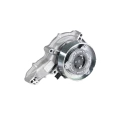
A weak or failing water pump may circulate enough coolant while the engine is idling but struggle once the engine is under greater load.
When you accelerate, drive uphill, tow, or travel at highway speed, the engine produces more heat and requires stronger coolant circulation. If the pump is worn, damaged, or its impeller is slipping, the temperature may rise only while driving.
Other possible signs of a failing water pump include:
♦ Coolant leaking near the front of the engine
♦ A whining or grinding noise
♦ Engine temperature that rises during acceleration
♦ Intermittent overheating
♦ Coolant residue around the pump
The water pump should be tested before replacement because a restricted radiator or thermostat problem can cause similar symptoms.
A radiator does not need to be completely blocked to cause overheating.
A partial internal restriction may still allow enough coolant flow while the engine is idling. Once the vehicle is driven for a longer period or the engine produces more heat, the radiator may no longer be able to cool the fluid effectively.
Signs of a restricted radiator may include:
♦ Overheating mainly at highway speed
♦ Temperature rising after 20 to 30 minutes of driving
♦ Uneven hot and cold areas across the radiator
♦ Rusty, contaminated, or discolored coolant
♦ Previous use of stop-leak products
A mechanic may inspect radiator temperature differences or coolant flow to determine whether a restriction is present.
A thermostat can fail without becoming completely stuck.
If it opens only partway, it may allow enough coolant circulation at idle but restrict flow when the engine is producing more heat.
Possible thermostat-related symptoms include:
♦ The temperature rises under acceleration
♦ The upper radiator hose stays relatively cool
♦ The temperature suddenly spikes and then drops
♦ The vehicle takes unusually long to warm up or overheats unpredictably
The thermostat should be tested rather than replaced automatically because several other cooling-system problems can produce similar symptoms.
A radiator hose may look normal from the outside but become soft or damaged internally.
Under certain operating conditions, the hose can partially collapse and restrict coolant flow. This is less common than a radiator, thermostat, or water-pump problem, but it can be difficult to identify without inspecting the hose while the engine is running.
Warning signs may include:
♦ A visibly flattened hose
♦ A soft or spongy hose
♦ Overheating at higher engine speeds
♦ Coolant flow that appears restricted
♦ A missing or damaged internal hose reinforcement spring
A head-gasket problem should not be assumed immediately, but it must be considered if the simpler cooling-system checks do not reveal the cause.
Combustion gases may enter the cooling system when the engine is under load, creating excess pressure and interfering with coolant circulation.
Possible signs include:
♦ Coolant slowly disappearing without an external leak
♦ Bubbles in the coolant reservoir
♦ White exhaust smoke
♦ Rough running or misfires
♦ Coolant being pushed out of the reservoir
♦ Repeated overheating during acceleration or highway driving
A combustion-gas test, cooling-system pressure test, or cylinder leak-down test may be needed to confirm the problem.
One of the quickest ways to narrow down the problem is by paying attention to exactly when your vehicle overheats.
If the temperature only climbs while driving on the highway, the radiator may not be removing enough heat because of an internal restriction.
If the engine overheats while accelerating, climbing hills, or towing, a weak water pump may not be circulating coolant fast enough to keep up with the increased heat.
If the heater suddenly begins blowing cold air while the engine is overheating, low coolant or air trapped inside the cooling system should be high on the list of possible causes.
If coolant slowly disappears without an obvious leak, an internal leak such as an early head gasket failure becomes more likely.
These symptoms don't confirm the diagnosis by themselves, but they provide valuable clues that help determine what should be tested first.
If the problem gets worse when:
You accelerate
You go uphill
You’re driving longer distances
Start thinking coolant flow, not airflow
That alone rules out a lot of wrong guesses.
Customer said:
"The temperature gauge stayed normal around town but started climbing every time I drove on the highway"
At idle? Totally fine.
Diagnosis:
Our inspection found that the radiator was partially clogged internally, restricting coolant flow under higher engine loads.
Repair:
The radiator was replaced, the cooling system was flushed, and the vehicle maintained normal operating temperature during the final road test.
This one was interesting.
Diagnosis
The cooling fan operated normally and the coolant level was full. Further inspection revealed that the water pump was no longer circulating coolant efficiently under higher engine loads.
Repair
The water pump was replaced, the cooling system was bled, and the vehicle maintained normal operating temperature during the final road test.
This one looked minor at first.
Overheating under load, but nothing obvious.
Diagnosis
The cooling system pressure test revealed combustion gases entering the cooling system. Additional testing confirmed an early-stage head gasket failure before major engine damage occurred.
Repair
The customer was able to schedule repairs before the overheating caused severe engine damage, avoiding a much more expensive repair later.
Makes sense in theory but not in this case.
At speed, airflow isn’t your problem.
This is where money gets wasted.
We’ve seen people replace:
Thermostat
Radiator
Sensors
…and still have the same issue.
A small cooling issue doesn’t stay small for long.
Finding the real cause of an overheating problem isn't about guessing which part to replace. It requires a systematic inspection of the entire cooling system.
A mechanic will usually begin by checking the coolant level and condition before inspecting the radiator, hoses, reservoir, and water pump for leaks or damage.
The cooling system is then pressure tested to identify leaks that may only appear when the engine is hot and under pressure.
If no leaks are found, the radiator is checked for restrictions, the thermostat is tested to verify that it opens fully, and the water pump is evaluated to make sure it's circulating coolant properly.
If those components appear to be functioning normally, additional testing such as a combustion gas test may be performed to determine whether an early head gasket problem is allowing exhaust gases to enter the cooling system.
Following this process helps identify the actual cause of the overheating and prevents unnecessary parts from being replaced.
One of the biggest mistakes we see is replacing parts based on assumptions instead of testing.
Many people replace the thermostat because it's relatively inexpensive, only to discover that the radiator is partially clogged.
Others replace the radiator when the real problem is a weak water pump that isn't circulating coolant properly.
We've also seen customers replace temperature sensors and cooling fans before discovering the engine simply had a slow coolant leak or an early head gasket problem.
Proper diagnosis almost always costs less than replacing several good parts.
Sometimes, yeah.
Not always but this type of overheating is more likely to be tied to bigger issues than idle overheating.
Watch for:
Coolant disappearing
White smoke
Engine running rough
Overheating getting worse over time
If you’re seeing those together, don’t wait on it.
This is where things can go sideways pretty fast.
Continued overheating can lead to:
Warped engine components
Head gasket failure
Complete engine damage
And once it gets to that point, you’re not talking about a small repair anymore.
Not exclusive but these come up a lot:
Ford Fusion / Focus
Honda Accord / Civic
Toyota Camry
Chevy Malibu
Nissan Altima
Although this problem can occur on almost any vehicle, we commonly diagnose it on popular models such as the Ford Fusion, Ford Focus, Honda Accord, Honda Civic, Toyota Camry, Toyota Corolla, Chevrolet Malibu, Chevrolet Cruze, Nissan Altima, Nissan Rogue, Hyundai Sonata, Kia Optima, Jeep Grand Cherokee, and Dodge Charger.
Every diagnosis is different, but aging cooling system components, restricted radiators, weak water pumps, thermostat failures, and coolant leaks are among the most common causes we encounter.
The cost of repairing an overheating problem depends entirely on what's causing it.
Minor coolant leaks are often the least expensive repairs and may cost between $150 and $500, depending on the location of the leak and the parts involved.
Thermostat replacement generally ranges from $150 to $400, while water pump replacement often costs between $400 and $1,200, depending on the engine design.
Radiator replacement commonly falls between $400 and $1,300, although certain vehicles may cost more.
If the problem turns out to be a blown head gasket, repairs can range from $2,000 to $5,000 or more, making early diagnosis extremely important.
Because several different cooling system problems can produce nearly identical symptoms, professional testing is usually the best way to avoid unnecessary repairs.
Overheating problems often produce nearly identical symptoms even though the underlying cause may be completely different. Replacing parts without proper testing can quickly become expensive and may not solve the problem.
At Instant Car Fix, our mobile mechanics diagnose the cooling system first, identify the root cause, and recommend only the repairs your vehicle actually needs. That helps prevent unnecessary parts replacement while reducing the risk of costly engine damage.
When your car is idling, there’s very little natural airflow going through the radiator. That means the cooling system relies heavily on the radiator fan to pull air through and keep temperatures down. If the fan isn’t working properly or airflow is restricted, the engine can overheat while sitting still.
If this sounds like your situation, see our full guide.
Driving an overheating vehicle is never recommended, even if the temperature only rises while you're moving.
If the temperature gauge continues climbing, steam begins coming from under the hood, coolant starts leaking, or warning lights appear, pull over immediately and allow the engine to cool.
Continuing to drive an overheating engine can warp cylinder heads, damage the head gasket, and in severe cases require complete engine replacement.
Catching the problem early is almost always far less expensive than repairing extensive engine damage.
If your car overheats while driving but not at idle, it’s not random and it’s not something to ignore.
Most of the time, it starts as a manageable issue.
But if it’s left alone, it tends to turn into something a lot more expensive.
Better to catch it early, figure out what’s actually going on, and fix it properly. Whether the problem turns out to be a weak water pump, clogged radiator, failing thermostat, or an early head gasket issue, diagnosing it early can prevent much more expensive repairs. If your vehicle repeatedly overheats while driving but returns to normal at idle, have the cooling system inspected before continued driving causes additional engine damage.


When your vehicle is moving, especially at highway speeds or while accelerating, the engine generates much more heat than it does at idle. If the cooling system cannot circulate coolant efficiently or remove enough heat through the radiator, the temperature may rise only while driving. Common causes include a weak water pump, restricted radiator, thermostat problems, or low coolant.
Yes. A failing water pump may still circulate enough coolant while the engine is idling but struggle once the engine is under heavier load. As engine speed and heat production increase, inadequate coolant flow can cause the temperature to climb during normal driving.
This usually indicates that the cooling system cannot keep up with the increased heat produced during highway driving. A partially clogged radiator, weak water pump, thermostat that isn't opening completely, or low coolant level are among the most common causes.
Absolutely. A vehicle with slightly low coolant may appear to operate normally at idle but begin overheating once the engine is working harder. Low coolant also allows air to enter the cooling system, reducing its ability to transfer heat effectively.
Yes. A thermostat that only opens partially may provide enough coolant flow while the engine is idling but become restrictive under heavier loads. This can cause the engine temperature to rise during highway driving, acceleration, or climbing hills.
No. Even if the engine cools back down after stopping, repeated overheating can damage the head gasket, warp cylinder heads, or lead to complete engine failure. If the temperature gauge continues to rise, pull over safely and allow the engine to cool before driving any farther.
A mechanic will typically inspect the coolant level, pressure test the cooling system, check for leaks, verify thermostat operation, inspect radiator flow, and evaluate water pump performance. If those components appear normal, additional testing may be performed to check for combustion gases that could indicate an early head gasket problem.
The repair cost depends entirely on what's causing the overheating. Minor coolant leaks or thermostat replacements are generally less expensive, while radiator replacement, water pump replacement, or head gasket repairs can cost significantly more. A proper diagnosis helps prevent replacing unnecessary parts.
Although every vehicle is different, the most common causes include a weak water pump, partially clogged radiator, thermostat that isn't opening fully, low coolant level, and cooling system leaks. Proper testing is the only reliable way to determine which component has actually failed.
Yes. A radiator can become partially restricted over time due to corrosion, mineral deposits, or contaminated coolant. It may still provide enough cooling while the engine is idling, but once the engine is producing more heat during normal driving, the restriction can cause the temperature to rise.
Get a real Car Overheating While Driving But Not at Idle Diagnosis service from a mobile mechanic near you, no workshop visit needed.
No commitment • See pricing instantly

Zack was very professional and did a great job fixing my car during the estimated time he provided. We would definitely use this service again.


Great customer service! Real person answered every phone call right away and was able to assist quickly. I got the pre-purchase inspection I needed. Detailed notes, multiple photos. Very satisfied. A+

Zach was great is work with. Showed up in the expected time frame, got the work done quickly as well.

Jamie arrived on time, diagnosed my car’s issue and provided a quote for the repair. I will definitely use again if needed.

Diego has great customer service. He was very fast and professional. He also gave me a few tips for any other problems

My Jaguar battery was dead and I had no way of accessing it since it is located in the trunk….and I could not open the trunk since the battery was dead😵💫. Contacted Instant Car Fix and a mechanic was dispatched with a new battery. He was great! Got the trunk opened by jumping a terminal under the hood. Installed the new battery and the car was good to go! Great service by an experienced mechanic! Thanks!

J e a n was very helpful to me I'm hoping my problem has been resolved very patient and very professional I recommend them to other people

Had Caleb do a pre-purchase inspection on a Jeep I was buying from Missouri, and the guy was great. Really thorough — found stuff I would’ve missed, told me straight what was worth fixing and what wasn’t. No runaround, answered all my questions fast. If you’re buying a used rig, don’t skip this step. I highly recommend.

Lovely service, very fast, the car was fully fixed, battery change was super fast and oil change. Very grateful!

Zack was very professional and did a great job fixing my car during the estimated time he provided. We would definitely use this service again.
Great customer service! Real person answered every phone call right away and was able to assist quickly. I got the pre-purchase inspection I needed. Detailed notes, multiple photos. Very satisfied. A+
Zach was great is work with. Showed up in the expected time frame, got the work done quickly as well.
Jamie arrived on time, diagnosed my car’s issue and provided a quote for the repair. I will definitely use again if needed.
Diego has great customer service. He was very fast and professional. He also gave me a few tips for any other problems
My Jaguar battery was dead and I had no way of accessing it since it is located in the trunk….and I could not open the trunk since the battery was dead😵💫. Contacted Instant Car Fix and a mechanic was dispatched with a new battery. He was great! Got the trunk opened by jumping a terminal under the hood. Installed the new battery and the car was good to go! Great service by an experienced mechanic! Thanks!
J e a n was very helpful to me I'm hoping my problem has been resolved very patient and very professional I recommend them to other people
Had Caleb do a pre-purchase inspection on a Jeep I was buying from Missouri, and the guy was great. Really thorough — found stuff I would’ve missed, told me straight what was worth fixing and what wasn’t. No runaround, answered all my questions fast. If you’re buying a used rig, don’t skip this step. I highly recommend.
Lovely service, very fast, the car was fully fixed, battery change was super fast and oil change. Very grateful!